Explain the characteristics and spatial distribution of the following hazards using at least two specific examples.
Natural hazards are a natural threat that has the potential to cause loss of life, injury, property damage, socio-economic disruption or environmental degradation. Some examples of natural hazards include earthquakes, volcanic eruptions, tsunamis, hurricanes, typhoons, and drought. Some natural hazards could be made worse due to human activites. For an earthquake human activities such as coal mining, drilling for oil, or nuclear testing can cause earthquakes. An earthquake is a sudden, violent shaking of the earth's surface. It lasts for seconds but can cause major destruction especially in heavily populated areas. Powerful aftershocks could also be felt for a long time after the main earthquake has occurred.There are different kinds of earthquakes, although all earthquakes involve the shaking of the earth due to tectonic plate movement. There are generally two kinds of natural earthquakes; the first are deep focused earthquakes which involves an oceanic plate being forced under a continental plate. The second being shallow focused earthquakes, along constructive and conservative tectonic plate boundaries. The difference between the two, being the depth where the earthquake is taking place. Deep focused earthquakes take place deep underground while shallow focus earthquakes take place relatively close to ground level. There are also intraplate earthquakes that take place within a tectonic plate rather than the boundary of tectonic plates. This occurs due to the compression of rocks. These are the type of earthquakes found in Tazmania and Australia. There are also volcanic earthquakes where magma fractures rock and squeezes through the cracks, thus causing an earthquake.
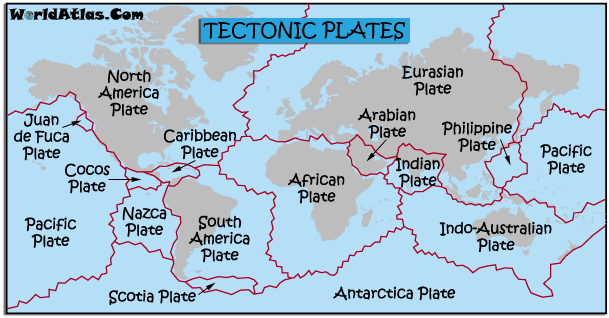
Earthquakes tend to occur in the same place. This is because they occur along plate boundaries. Generally, a large amount of earthquakes occur in destructive plate boundaries, subduction zones, and collusion boundaries. For example, the Himalayas mountains are the result of collision boundaries. There are a large amount of earthquakes over a large area along the Indian and Eurasian plate boundary. Aside from the Himalayas, earthquakes occur around the edge of the pacific ocean, down the center of the atlantic ocean, around the Caribbean archipelago, the Philippine and Indonesian archipelago, east Africa, south Asia, and southern Europe. On the other hand, conservative plate boundaries such as the California San Andreas fault line, and constructive plate boundaries produce a small area of earthquake occurrences.
 |
| Note how the earthquakes occur at tectonic plate boundaries |
As stated before, earthquakes last for seconds, however aftershocks may occur after the main quake. Aftershocks can last up to days after the main quake. For example, the Tohoku earthquake that occurred in Japan in April 2011 had aftershocks until as far as December 7, 2012. The magnitude of the main earthquake was measured 9.0 using a richter scale, which is the standard measurement of the strength of an earthquake. This earthquake and the consequent tsunami has 13,135 fatalities.
As stated before, earthquakes last for seconds, however aftershocks may occur after the main quake. Aftershocks can last up to days after the main quake. For example, the Tohoku earthquake that occurred in Japan in April 2011 had aftershocks until as far as December 7, 2012. The magnitude of the main earthquake was measured 9.0 using a richter scale, which is the standard measurement of the strength of an earthquake. This earthquake and the consequent tsunami has 13,135 fatalities.
Another example of a major earthquake is in the Philippines, a magnitude of 6.9 earthquake hit Negros, the rest of central Visayas, and some parts of Mindanao on February 6, 2012. It was at a depth of 20km. The death toll was 51, 62 missing, and 112 injured. 15,483 houses were damaged. Total cost of repair equaled 383 million pesos.
In conclusion, the sudden unpredictable nature of earthquakes can cause major damage in heavily populated areas such as what occurred in Japan and in the Philippines, but in general the majority of earthquakes are harmless and occur any tectonic plate boundary.

Earthquakes are measured using a seismometer, which gives the strength of the earthquake using the richter magnitude scale. The magnitude scale is from 1 to 10. A strong earthquake that would cause major damage would be a magnitude of 6 on a richer scale. Earthquakes are not easily predictable because the only signs of a large, impending earthquake are foreshocks (pre-earthquakes) which can easily be mistaken as small, negligible earthquakes that happen very often. The magnitude of an earthquake is proportional to the frequency of occurrence. Generally, the higher the magnitude, the less the occurrence. For example, magnitude of less than 2 on the richter scale, happen several million times in one year, while 9 or greater will occur once in 10 to 50 years. All main earthquakes are predicted seconds before it happens and lasts for tens of seconds.

No comments:
Post a Comment